

In polycystic ovary syndrome, irregular periods are not simply "the inconvenience of an erratic cycle"; left unaddressed for a long time, they can be a signal that affects the uterine lining. In the clinic, it is not rare to see patients who say "not having periods is actually more comfortable" and go months, sometimes close to a year, skipping periods before coming in belatedly. Polycystic ovary syndrome (PCOS) is a common reproductive endocrine disorder, affecting 8–13% of women of reproductive age, and because it is common it is easy to brush off as "probably nothing." In this article, rather than the outwardly visible symptoms such as acne or weight, I want to focus on what skipping periods means inside the uterus.
Why periods become irregular in polycystic ovary syndrome
At the root of irregular periods lies "anovulation," in which ovulation does not occur well, or "infrequent ovulation." In polycystic ovary syndrome, the hormonal signaling system linking the brain and the ovaries becomes disrupted, so the ovaries and adrenal glands secrete relatively more androgens (male hormones), and this is compounded by insulin resistance, in which insulin cannot do its job. As a result, the process by which a follicle matures and leads to ovulation does not proceed smoothly.
When ovulation is skipped, the menstrual cycle lengthens or goes empty for months at a time. Patients sometimes accept this as "the body resting on its own," but from a gynecological standpoint it is closer to the opposite. When there is no ovulation, progesterone from the corpus luteum is not produced, and the uterine lining is left receiving only the one-sided stimulation of estrogen.
Skipping periods may not mean the uterus is resting, but that it keeps receiving the signal of only one hormone.
What happens in the uterine lining when periods are skipped
In a normal cycle, in the first half estrogen builds up the uterine lining, and after ovulation progesterone stabilizes that lining before it sheds cleanly as a period. This rhythm of "building up – tidying – emptying" is key to keeping the uterine lining healthy.
But when ovulation is frequently skipped, as in polycystic ovary syndrome, estrogen stimulation accumulates without progesterone's tidying action. In medicine this is called unopposed estrogen exposure, and the American College of Obstetricians and Gynecologists (ACOG) explains that if this state persists for a long time, it can lead to endometrial hyperplasia, in which the uterine lining proliferates excessively (ACOG, 2023). Among the forms of hyperplasia, some atypical forms are classified as a precursor stage of endometrial cancer.
The 2023 International Evidence-based Guideline acknowledges that the risk of endometrial cancer may be somewhat elevated in premenopausal women, while also emphasizing that the absolute risk itself is low. In other words, it is not something to be excessively anxious about, but it should be read as meaning that leaving a situation of long-term skipped periods as it is should be avoided.
There are separate factors that increase the risk
Not every patient with polycystic ovary syndrome needs to worry about the uterine lining to the same degree. Even with the same diagnosis, the more the following factors overlap, the more attention we pay to the uterine lining.
- A long duration of skipped periods (repeated amenorrhea over several months or more)
- Significant weight gain or accompanying obesity
- Metabolic problems such as insulin resistance or prediabetes
- Abnormal bleeding at times unrelated to menstruation
Abnormal bleeding in particular is a signal that is easy to let slip by. In the clinic, some patients feel reassured that "I finally got my period after a long time," but it may be bleeding that comes as part of a long-thickened lining breaks down. If there is bleeding different from your usual pattern, it is safer to check once through evaluation for menstrual pain and irregularity or amenorrhea testing.
If the diagnosis or symptoms are ambiguous and hard to judge, I recommend a consultation rather than reaching a conclusion alone through searches. Get a consultation for irregular-period symptoms
How is the diagnosis made
The most widely used diagnostic criteria internationally are the Rotterdam criteria. Polycystic ovary syndrome can be diagnosed if two or more of the following apply: irregular periods (anovulation or infrequent ovulation), clinical or blood-test evidence of androgen excess, and polycystic ovary findings on ultrasound. However, since in adolescence this overlaps with the natural physiological changes of puberty, the 2023 international guideline states that diagnosis should be made at least 2 years after menarche, and ultrasound in this period is not recommended as a diagnostic criterion.
From the perspective of the uterine lining, an important examination is pelvic ultrasound. The Royal College of Obstetricians and Gynaecologists (RCOG) guideline recommends checking the thickness and condition of the uterine lining with transvaginal ultrasound when a patient with polycystic ovary syndrome has had no periods (withdrawal bleeding) for a long time or has abnormal bleeding (RCOG, 2014). In the clinic, while distinguishing the cause of irregular periods, we also look at whether there are other factors such as uterine fibroids or changes in the uterine lining.
| Situation | Approach commonly considered in the clinic |
|---|---|
| Skipping periods for several months or more | Check the cause and uterine lining with hormone tests and pelvic ultrasound |
| Accompanied by abnormal bleeding | Transvaginal ultrasound and, if needed, additional tests to evaluate the uterine lining |
| Pregnancy is planned | Management focused on restoring ovulation and the cycle |
To protect the uterine lining, you need to create a cycle
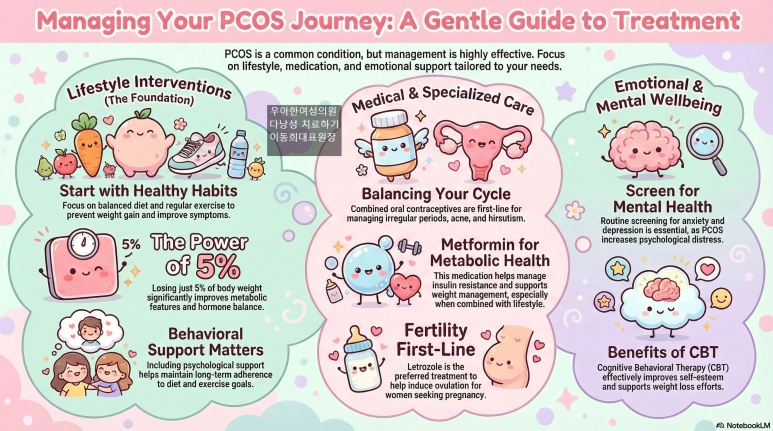
One of the major goals of managing polycystic ovary syndrome is to create "a flow that regularly empties the uterine lining." The most basic first-line management is lifestyle improvement, and it is reported that weight loss through diet and exercise alone can improve ovulation and hormonal indices. If there is a large change in weight, it helps to also understand the connection between weight gain and amenorrhea.
In medication management, the choice differs by purpose. The 2023 international guideline presents the combined oral contraceptive pill as a first-line drug treatment for irregular periods and androgen symptoms (acne, hirsutism), and notes that when the pill is difficult to use, a progestin-only preparation can be used to protect the uterine lining. The RCOG guideline likewise describes a strategy of inducing withdrawal bleeding with periodic progestogen to tidy the uterine lining in patients who do not use the pill (RCOG, 2014). Since which approach is right depends on age, pregnancy plans, and metabolic status, it is best to decide in consultation with a specialist.
On the metabolic side, metformin, known as a diabetes drug, can help with insulin resistance and weight management, and recently GLP-1 analog class treatments have also been used to improve weight and metabolic indices. If you are planning a pregnancy, letrozole is recommended as the first-line ovulation-induction agent, and it is reported to raise live-birth rates compared with the existing clomiphene.
It is right to view it as lifelong management
Polycystic ovary syndrome is less a disease that is "cured" with a single treatment and closer to a chronic condition whose management goals change according to life stage. In one's twenties the focus is on the menstrual cycle and skin symptoms; in the period of preparing for pregnancy, on ovulation; and after that, the center of gravity shifts to metabolic disease and uterine-lining health. In clinical experience, when management is completely let go because symptoms have quieted down, irregular periods often return, deepened, a few years later.
The key is not a short-term cure but steadily maintaining "a rhythm of emptying" so that the uterine lining is not exposed to only one hormone for a long time. If you have been skipping periods for a long time, or feel lost about how to manage things even after a diagnosis, I recommend not leaving it unaddressed and starting with a check-up.
Management of polycystic ovary syndrome, get a consultation
Written by: Lee Dong-hee Director · Obstetrics and Gynecology Specialist · See physician profile
First published March 9, 2026 · Last reviewed May 30, 2026
References: 2023 International Evidence-based Guideline for the Assessment and Management of Polycystic Ovary Syndrome (2023), American College of Obstetricians and Gynecologists (2023), Royal College of Obstetricians and Gynaecologists Green-top Guideline (2014)
This article is intended to provide general health information and does not replace individual diagnosis or treatment. If you have symptoms, please consult through a medical visit.