

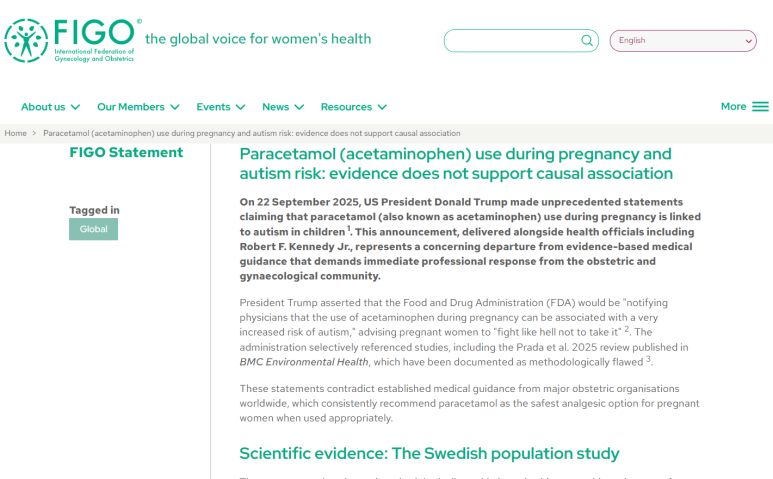
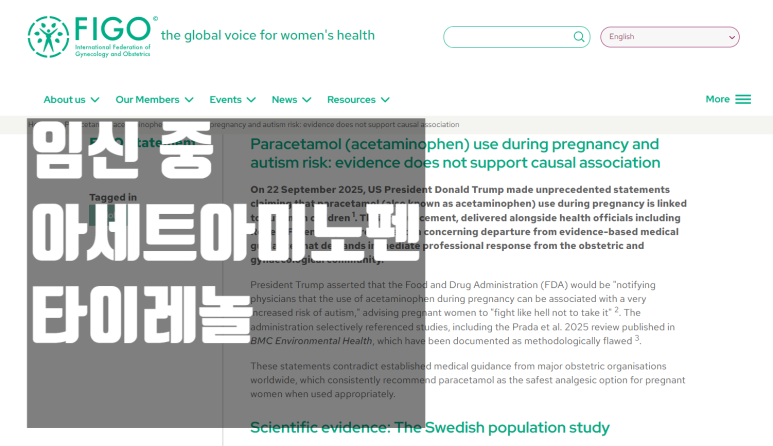
Prompted by a political statement that came out in the US in September 2025, the claim that taking Tylenol (acetaminophen) during pregnancy causes autism spread quickly. In the clinic, the first questions pregnant women throw out are always similar. I have a fever, can I take medicine; could it possibly harm the baby? This article is not written to declare one side or the other. It lays out together the studies that reported an association and their limitations, along with the latest evidence from the most rigorous design, and aims to look in a balanced way even at the risk of leaving fever and pain untreated.
Where did the controversy begin
The starting point of this confusion was not new decisive evidence, but a review that re-bundled existing observational studies and a political statement layered on top of it. Some of the cited reviews (e.g., Prada et al., 2025) measured drug-taking during pregnancy relying on the pregnant women's memory, lacked information on dose and duration, and analyzed results diagnosed by different assessment tools all mixed together. In such a design, residual confounding—where the reason for taking the drug itself influences the outcome—easily remains.
Controversy surrounding the authors' conflicts of interest was also raised. The important point is the fact that this was not new experimental data but a matter of interpretation. Since even the same raw data can yield different conclusions depending on the design used to analyze it, we should not look only at the direction of the result but first scrutinize how much the study controlled for confounding. If those facing pregnancy and childbirth keep this point in mind when encountering drug information, they can considerably reduce being swayed by sensational headlines. This context is a topic often dealt with in the tests worth getting before pregnancy consultation.
What the sibling-control studies showed
The most noteworthy evidence is the Swedish total-population cohort study published in JAMA in 2024. It is a large study that followed about 2.48 million people born from 1995 to 2019, and in the traditional model a very slight association was observed for autism and ADHD (hazard ratio roughly around 1.05).
Yet when siblings within the same family were compared with one another, that association practically disappeared. Autism was reported with a hazard ratio of 0.98 (95% confidence interval 0.94–1.02), ADHD 0.98 (0.95–1.01), and intellectual disability 1.01 (0.96–1.07), so when family factors like genetics and home environment were controlled for, the signal was lost. Autism is a condition with a strong tendency to co-occur among siblings, so a family-based design is especially advantageous for confounding control.
Siblings share, to a considerable degree, genes and the upbringing environment, the parents' health, and socioeconomic background. So the disappearance of the association in the sibling comparison suggests the possibility that the previously seen signal was due not to the drug but to the background shared by the family.
The same trend was confirmed in Japan's nationwide large-scale cohort study. A positive association appeared in the general model, but when analyzed by sibling comparison the association disappeared. The point that it converged to the same conclusion across different countries and different populations adds weight to the evidence.
Examining the limitations of the association studies
Just because a signal appears between a drug and an outcome in an observational study, it should not be read immediately as causation. From clinical experience, even the same data yields different conclusions depending on how the limitations are handled. The main limitations are organized as follows.
- Inaccuracy of exposure measurement: relying on after-the-fact memory for drug-taking during pregnancy produces recall bias. It is reported that parents whose child has a condition tend to remember drug-taking more clearly.
- Lack of dose·duration·timing information: not knowing how much, how long, and at what gestational week it was taken makes it hard to judge the dose-response relationship.
- Inconsistency of outcome definition: bundling autism and attention problems with different assessment tools increases heterogeneity and blurs interpretation.
- Residual confounding: the reason for taking the drug itself, namely pain or fever (confounding by indication), genetic predisposition, and environmental factors can act together on the outcome.
So even if a weak signal at the level of relative risk 1.1 to 1.3 appears in some meta-analyses, if that signal disappears in more rigorous designs like sibling comparison or negative-control exposure, the claim of causation loses force. Evidence must be judged not only by the direction of the result but by the quality of the design.
The positions of major societies and regulatory agencies
The positions of obstetrics and gynecology societies and drug regulatory agencies worldwide are consistent as of 2025. The recommendation to use it with appropriate usage·dose when there is an indication is maintained.
| Agency | Time of announcement | Core position |
|---|---|---|
| ACOG American College of Obstetricians and Gynecologists | September 2025 | Reaffirmed that causation is not proven and use during pregnancy is safe |
| SMFM Society for Maternal-Fetal Medicine | 2025 | States that, by the weight of scientific evidence, causation has not reached a conclusion |
| RCOG UK · FIGO International Federation | 2025 | Maintains recommendation as a first-line analgesic·antipyretic option when there is an indication |
| FDA US · EMA Europe · MHRA UK · TGA Australia · Health Canada | 2025 | Maintains current use recommendation, repeatedly states causation is not established |
SMFM, in its 2025 statement, conveyed the intent that pregnant women can be reassured about using acetaminophen to treat pain and fever. However, there is movement, as with the FDA, to reflect the latest research trends in the label wording, so it is worth knowing that the level of expression differs slightly by agency on the same matter.
If you are worried about taking medicine and have been delaying a decision, please check your drug-use plan together through chat consultation.
The risk of leaving fever and pain untreated
The thought that unconditionally avoiding medicine is safer is a common misconception. In the clinic, because of this misconception, there are those who endure a high fever before coming in.
If a high fever in early pregnancy is not treated, it is reported to be associated with increased risks such as miscarriage, neural tube defects, and some heart malformations. Leaving persistent fever or pain in mid-late pregnancy untreated can also be related to preterm birth and fetal growth restriction. Acetaminophen is a World Health Organization (WHO) essential medicine, and when used at an appropriate dose and for the shortest duration, it is established as a standard treatment option during pregnancy.
In other words, the choice is not the simple dichotomy of drug or no drug. You have to put on the scale together the actual risk that untreated fever and pain bring, and the theoretical concern arising from studies with large methodological limitations, and judge. If you have gynecological symptoms accompanied by fever or pain during pregnancy, it is safer to confirm the cause through a medical visit than to endure it.
In actual practice we guide as follows
The core principle is to use the minimum effective dose for the shortest duration. The indications are fever, especially fever control in early pregnancy, and pain control within the permissible range.
Conversely, what should be avoided is the pattern of taking it habitually at a high dose for a long period without a medical visit. If anxiety is great, alternative strategies or dose adjustment can be discussed together, and it is safe to set up an individual plan tailored to underlying conditions, concomitant medications, and gestational week. Pain and fever during pregnancy consume not only the body but also the mind. I think the role of medical care is to give together reassuring evidence and realistic alternatives. At the Pregnancy and contraception clinic, we conduct such tailored consultations routinely.
If I organize the frequently asked questions, they are as follows.
- Should Tylenol during pregnancy be entirely banned? No. With appropriate usage·dose, it is recommended as a first-line option.
- Is the news that it raises autism risk correct? In high-quality studies like sibling comparison the association is lost, and the consensus is that, for now, the evidence for causation is not sufficient.
- Is it okay to hold out without an antipyretic? The risk of not treating a high fever is clearer. Appropriate fever·pain control is beneficial for both the pregnant woman and the fetus.
In closing
The latest evidence, including even the most rigorous sibling-comparison design, does not support a causal relationship between acetaminophen use during pregnancy and autism. At the center of the evidence is the result that the hazard ratio stayed almost at 1.0 in the sibling comparison of the 2024 JAMA Swedish total-population cohort (about 2.48 million births), and Japan's large-scale study also reached the same conclusion.
The practice recommendation is also clear. ACOG, RCOG, FIGO, SMFM and major regulatory agencies continue to recommend acetaminophen as the first-line antipyretic·analgesic during pregnancy on the premise of appropriate usage·dose, and view the risk of untreated fever and pain as greater. However, for drugs during pregnancy, the individual situation is most important. A process of setting up a tailored use plan, synthesizing the drugs currently being taken, the pattern of symptoms, and the gestational week, is needed.
If a single line of news has weighed on your mind, please get consulted on your drug-use plan with accurate information. Woo-ah Women's Clinic is an obstetrics and gynecology clinic that looks after women's body and mind together, and carefully guides health before and after pregnancy and childbirth.
Written by: Lee Dong-hee Director · Obstetrics and Gynecology Specialist · View doctor profile
First published September 29, 2025 · Last reviewed May 30, 2026
References: Ahlqvist et al. JAMA (2024), ACOG Practice Advisory (2025), SMFM Statement (2025), FIGO·Louwen et al. International Journal of Gynecology & Obstetrics (2025), EMA·FDA·MHRA·TGA·Health Canada regulatory agency positions (2025)
This article is intended to provide general health information and does not replace individual diagnosis or treatment. If you have symptoms, please consult through a medical visit.