

"Doctor, I was so clean my whole life that I never even had discharge on my underwear, but after menopause I suddenly sting and keep getting inflammation." This is the most common worry I hear from women in their 40s and 50s in the clinic, yet one that is hard to bring up elsewhere. To get to the point: this is not because of neglected hygiene but a natural process in which, as the powerful protective barrier of hormones disappears, the vaginal mucosa itself changes. In medicine this change is called atrophic vaginitis, and more broadly, genitourinary syndrome of menopause. Don't blame yourself; let's carefully look at the cause together.
Atrophic vaginitis is not a simple infection but a change in which the mucosa thins
The essence of the vaginitis that grows frequent after menopause differs in nature from common fungal or bacterial infections. The key is the atrophic change in which, as estrogen decreases, the vaginal mucosa itself thins and dries. During the reproductive years, estrogen keeps the vaginal mucosa thick and moist and fills the mucosal cells with glycogen. As the beneficial bacterium Lactobacillus breaks down this glycogen, it produces lactic acid, and as a result the inside of the vagina is kept in an acidic environment.
When ovarian function stops with menopause, this virtuous cycle collapses. The mucosa thins, the folds smooth out, and lubrication decreases. Even slight friction, the pressure of underwear, or sex alone can easily cause injury, and through those tiny injuries bacteria can readily penetrate. Even ordinary bacteria that were once easily fended off now become causes of inflammation. In the clinic, many worry, "Has my immunity suddenly dropped?" but in most cases it is the result of a changed defensive structure in the single region of the vagina.
Why the acidic barrier collapses — the signal that pH reveals
The most intuitive indicator for understanding vaginal health after menopause is pH. According to material organized by the North American Menopause Society (NAMS) and others, the pH of an estrogen-sufficient reproductive-age vagina is generally maintained acidic, roughly between 3.8 and 4.2. This acidic environment serves as the first line of defense, preventing bad bacteria from growing freely.
But when estrogen decreases, the mucosal glycogen decreases, Lactobacillus decreases, and lactic acid production drops. As a result, cases are reported in which the vaginal pH rises above 5.5. When an acidic environment moves closer to neutral, it turns into soil favorable for various bacteria to grow, including the anaerobic bacteria that were once few.
It is like the vaginal environment changing from a sturdy wall that fended off external attack into a flimsy fence. So even when exposed to the same bacteria, what caused nothing before menopause leads to inflammation after menopause.
This change is not a one-off event but tends to progress over time. Unlike vasomotor symptoms such as hot flashes, which gradually subside over a few years, atrophic change differs in that, left unmanaged, it instead worsens slowly.
Not just a vaginal problem — the link between the gut and hormones
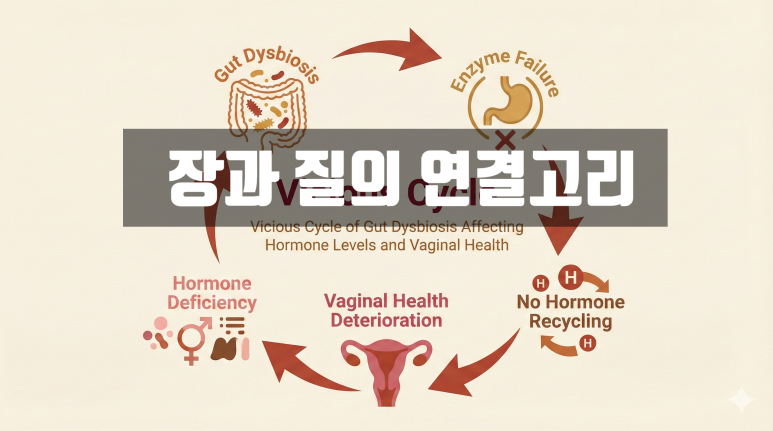
Surprisingly, the root of post-menopausal vaginitis lies not only in the "vagina" but is also connected to our body's "gut" health, a fact that has drawn attention recently. According to a study published in Gut Microbes in 2024, when ovarian function stops, it is not simply that hormone levels fall but that the body's whole microbial defense system is shaken together.
The latest review papers published in 2025 highlight the role of the estrobolome—the gut microbes that regulate estrogen metabolism—and an enzyme called beta-glucuronidase. To put it simply, some of the estrogen processed in the liver descends to the gut and is reactivated by the action of this enzyme to be reabsorbed into the body. But when the gut microbial balance is broken, this recycling process does not work properly.
As a result, the already-deficient hormone cannot be used more efficiently, and a vicious cycle can form in which whole-body estrogen deficiency worsens even the vaginal mucosa. In other words, it is more accurate to understand post-menopausal vaginitis not as a local event but as a systemic signal that appears as the gut environment and hormone metabolism change together.
The real reason it keeps recurring even after treatment
The biggest characteristic of atrophic vaginitis is that "it's fine for a moment after taking medicine, then recurs." In the clinic, many people take vaginitis medication repeatedly several times a year, and the reason is usually that two things have not been resolved at the same time.
- The atrophic state itself, where the mucosa is thin and dry, remains as is, so even after the bacteria are cleared, injury occurs again and penetration occurs again.
- With the Lactobacillus that protected the acidic environment still reduced, even after the bacteria are cleared once, other bacteria become dominant again.
In other words, treatment that targets only the infecting bacteria is like "putting out a fire," while addressing atrophy and microbial balance together is like "creating an environment where fire does not easily start." If you do not look at both, the loop of recurrence is hard to break. If you are troubled by repeated abnormal discharge or itching, refer to the guide on examining recurring vaginitis and uteritis, and organizing the pattern to tell us at your visit greatly helps narrow down the cause.
Recurring discomfort after menopause—ask first by chatWhat to address first at home — beneficial bacteria, dietary fiber, and habits to avoid
To rebuild a collapsed defense line, it is reasonable to start by recovering the beneficial bacteria that handle the first line of defense. In particular, it is reported that steadily supplementing Lactobacillus-type probiotics can help return the inside of the vagina toward a healthy acidic side.
At the same time, caring for gut health together is important. By taking enough dietary fiber, which feeds the probiotics, and tending the gut microbial ecosystem, you also contribute to improving the estrobolome environment mentioned earlier. Beyond merely aiding digestion, it becomes the most basic foundation of vaginal health and immunity for menopausal women.
On the other hand, among common folk remedies there are some that instead worsen the condition, so caution is needed.
| Common misconception | Reality |
|---|---|
| Washing with diluted vinegar returns it to acidic | It can further irritate the mucosa and even kill beneficial bacteria, so it is not recommended |
| Wash the inside thoroughly with soap | It can strip the protective barrier and increase dryness and inflammation |
| Lubricant alone solves atrophy too | It helps relieve symptoms but does not reverse atrophy itself |
For the inside of the vagina, it is enough to gently wash only the outer vulva with lukewarm water without using soap. If you are curious about everyday vulvar care, I also recommend reading how to care for vulvar skin.
What the hospital looks at — the big picture of diagnosis and treatment
Some people improve sufficiently with probiotics and lifestyle management, but if inflammation already recurs and pain is severe, lifestyle management alone has limits. At that point, an examination by an OB-GYN specialist is needed. In my clinical experience, when someone comes after enduring post-menopausal discomfort for a long time, accurately evaluating the degree of atrophy—rather than treating it as simple vaginitis—becomes the starting point of treatment.
The hospital grasps the degree of atrophy by combining the symptoms and mucosal condition and, if needed, pH or discharge tests. And when needed, local hormone treatment is considered. Low-dose local estrogen used directly in the vagina helps restore the mucosa to a thicker state and revive the acidic environment, and is reported to be absorbed systemically in small amounts. However, whether and how to use it differs by individual medical history, so it is always decided after consultation. If you are curious about how to use local estrogen safely, the usage and cautions for local estrogen covers it in more detail.
If your symptoms center on dryness and painful sex, self-care for menopausal vaginal dryness will help, and if you are curious about the changes of menopause overall, the body changes and mechanisms of menopause will. Which path is right ultimately depends on each person's condition.
Handle post-menopausal bleeding separately
Finally, there is one point I really want to emphasize. When the mucosa thins due to atrophic vaginitis, blood can appear even with mild stimulation, but the principle is not to conclude that all vaginal bleeding after menopause is due to atrophy, and to confirm it through an examination. This is because, although rare, causes other than mucosal atrophy must be ruled out.
Regular checkups and active management are the wisest way to care for yourself. Regarding post-menopausal bleeding, refer to post-menopausal bleeding—is it a period?, and if there is any bleeding even slightly different from usual, please do not put it off. Our Wooahan Women's Clinic will be by your side, carefully helping toward your healthy and comfortable life.
Start a symptom consultation by chatWritten by: Lee Dong-hee, Director · OB-GYN specialist · View doctor profile
First published January 15, 2026 · Last reviewed May 30, 2026
References: North American Menopause Society / ISSWSH GSM terminology (2014), Gut Microbes (2024), Estrobolome and gut-vagina axis reviews (2025), ACOG/IMS local vaginal estrogen guidance (2021), Frontiers in Reproductive Health GSM epidemiology review (2021)
This article is intended to provide general health information and does not replace individual diagnosis or treatment. If you have symptoms, please consult through an examination.